
Who Really Moves the Stock Market and Why It Matters
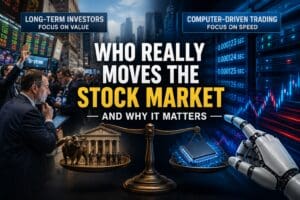
If you asked most investors who moves the stock market, they’d probably say individual investors, mutual funds, pension funds, and large investment firms buying and selling stocks based on what they believe companies are worth. That answer would have been largely correct a few decades ago. Today, it isn’t. The stock market has quietly undergone one of the biggest changes in its history. While long-term investors still own most of the market, they no longer generate most of the trading. Today, the overwhelming majority of stock trades are executed by computers.
At first glance, that may not seem important. After all, a trade is a trade, regardless of whether it’s placed by a person or a computer. But there is one important difference. Traditional investors commit their money because they believe businesses are worth owning. Computers commit money because they are programmed to profit from the trading process itself. For generations, investors studied company earnings, balance sheets, cash flow, and competitive advantages before deciding whether to buy or sell a stock. Their goal was simple: own good businesses and profit as those businesses grew over time.
Computers operate under a completely different set of rules. Some are programmed to profit from tiny price differences that exist for only fractions of a second. Others constantly buy and sell to capture small spreads between buyers and sellers. Some respond instantly to changing market conditions. Others simply follow mathematical instructions thousands of times every second. They are not making emotional decisions. They are not reading annual reports. They are not asking whether a company is worth owning for the next ten years. Their job is to trade.
None of this is necessarily bad. In fact, computers have made markets faster, more efficient, and less expensive to trade than ever before. Bid-ask spreads have narrowed, trades are executed almost instantly, and transaction costs have fallen dramatically. Those are real benefits for investors. But every benefit comes with tradeoffs. For most of the stock market’s history, much of the buying and selling came from investors whose objective was to own businesses. Today, a large share of daily trading comes from computers whose objective is simply to execute profitable trades. That doesn’t mean computers determine what businesses are worth, but they have become the dominant participants in day-to-day trading.
This is especially important at a time when stock valuations remain well above their long-term historical averages. High valuations don’t necessarily mean lower future returns, and they certainly don’t predict when markets will rise or fall. But they do mean investors are paying much more for each dollar of corporate earnings than they have historically. That leaves more room for disappointment than when stocks are trading closer to their long-term average valuations. No one knows exactly how today’s market structure will perform during the next major bear market. History can’t answer that question because history has never seen a market quite like this one. We know computers now execute most of the trades, while long-term investors account for a much smaller share of daily trading activity than in previous generations. We also know computers have made markets faster, more efficient, and less expensive to trade. Whether that ultimately makes markets more resilient or more fragile during periods of extreme stress is something only time will answer.
The purpose of this article isn’t to predict the future or tell you what to think. It’s simply to encourage you to understand the market you’re investing in is unlike any in the long history of the stock market. Successful investing begins with understanding how today’s market works, not how it worked thirty or forty years ago. Whether this new market structure ultimately proves to be more resilient or more fragile during periods of extreme stress is something only time will answer. And that’s precisely why understanding today’s market is so important, especially for retirees and other long-term investors whose financial security depends on it. Recognizing that distinction won’t tell you where the stock market is headed tomorrow, but it may help you better understand the market you’re investing in today. Because before you can understand where the stock market may be going, you first have to understand who really moves it.